InstaPay changed what “fast loan” means in the Philippines, and comparison platforms now advertise against that clock rather than against banking hours. Finami is an online loan matching service, not a lender: it takes one application, presents it to lenders and financial service providers in its network, and sends the applicant on to whichever partner accepts. This is a complete review of Finami in the Philippines, covering the amounts on offer, the very wide interest range in its legal information, who qualifies, what the platform does with an application, and the one worked cost example the site itself publishes. The same partner lenders can also be lined up on Lafingo, where amounts and advertised rates sit side by side instead of arriving one offer at a time.
Finami review in September 2026
Finami is a loan matching service and credit broker serving borrowers in the Philippines through finami.ph. Its Terms state plainly that Finami is not a lender or financial service provider and does not provide financing directly.
The operator is INFINSA LTD, company number 14523902, registered in Estonia with a registered office at Tartu mnt 52-166, 10115 Tallinn. The website itself operates under Philippine jurisdiction while the company sits in the EU.
Finami also states it may receive a fee from a lender or provider for connecting an applicant. That is the revenue model in one sentence: the borrower pays nothing, the partner pays for the introduction.
For a Filipino borrower the practical point is straightforward. The company that approves the loan, holds the contract and collects repayment is a third party, and that company is the one worth checking against the SEC advisories on lending and financing companies and against the verified options on legit online loans.

How much can you borrow through Finami
The Finami homepage calculator allows a request between ₱1,000 and ₱25,000. That range applies to the request, not to the approval.
Partner lenders advertise their own limits, and some sit above the site’s own selector. The offers page currently lists six lenders with the following advertised terms.
| Partner offer | Advertised maximum | Advertised interest | Advertised approval speed | Displayed approval probability |
|---|---|---|---|---|
| Zaimoo | ₱50,000 | 0% | From 15 minutes | 91% |
| Finpug | ₱30,000 | 0.01% daily | From 5 minutes | 44% |
| MoneyCat | ₱20,000 | 0% daily | From 5 minutes | 46% |
| Creditify | ₱25,000 | 0.1% | From 15 minutes | 43% |
| Yaloan | ₱25,000 | 0% | From 10 minutes | 67% |
| CreditYes | ₱25,000 | 0% | From 10 minutes | 77% |
Read the approval probabilities with care. They are numbers Finami displays next to offers, not independently verified approval rates, and the offers page does not establish that every applicant sees all six listings.
What interest rate does Finami charge
Finami sets no interest rate at all, because it does not issue the loan. The rate comes from whichever partner accepts the application.
Three different rate figures appear across the site, and they describe three different things. The homepage promotes 0% interest if the borrower repays on the first payment date. The legal information states that some partners have minimum rates of 0.01%. The same legal information gives a stated annual interest range of 4% to 916%.
That upper figure deserves a moment. An annual rate of 916% is not a typo and not a personalised quotation: it is the outer edge of what partners in the network may charge, and it exists in the same document as the 0% promotion. Anyone treating the headline as the real cost is reading the wrong number.
Finami also notes that its calculators use an average interest rate a financial institution may offer, not the rate on your own agreement. Run the partner’s actual figures through a loan calculator once the offer arrives, and verify the total repayment before calling anything interest free.
What does a ₱1,000 loan through Finami actually cost
Finami publishes one worked example in its legal information, and it is the only concrete cost figure on the site.
A ₱1,000 loan over 3 months at a 48% annual rate produces ₱120 in interest. The arithmetic is simple interest across the three months: 48% per year is 12% over a quarter, and 12% of ₱1,000 is ₱120.
Total repayment is ₱1,120. The total cost of credit is ₱120, or roughly one tenth of the amount borrowed for three months of use.
Two caveats attach to that number. The 48% rate used in the example sits near the bottom of the 4% to 916% band in the same document, so a real offer can cost considerably more. Finami’s legal information also mentions that a commission of 0.1% of the amount owed is charged in the event of a payment violation, though the wording does not make clear whether that charge comes from Finami or from a particular lending partner, or how often it applies.
How long do you have to repay
Finami’s legal information states that the services of the represented companies can be used for periods of 3 to 12 months inclusive.
Each partner sets the real schedule inside that band. The repayment dates, payment methods, early repayment conditions, extensions, refinancing and the consequences of a missed payment all live in the lender’s agreement, and Finami establishes no universal policy on any of them.
Borrowers who need a longer runway than twelve months should look at long-term loans instead, since that sits outside what this network covers.

Who can apply to Finami
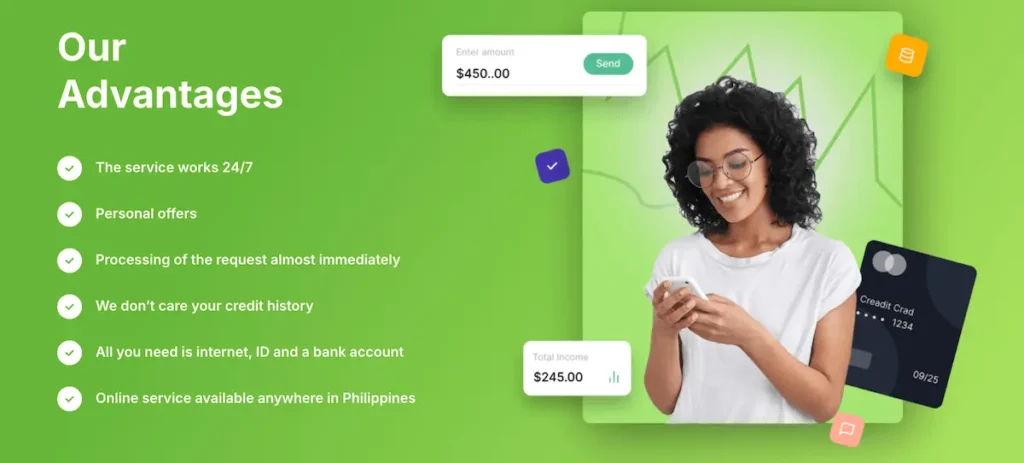
Finami’s homepage lists requirements that are unusually specific for a matching service. An applicant must be at least 18 years old, hold Philippine citizenship, present a citizen’s passport as identification, have internet access, and hold a bank account.
The passport requirement is worth flagging, since many Filipino applicants would reach for a UMID or driver’s licence first. Finami names the passport specifically on its homepage.
The bank account is not optional either, because the advertised disbursement runs through InstaPay. No account means no transfer route, regardless of approval.
Does Finami check your credit history
The homepage advertises that credit history is not taken into account. The Terms say something different: a lender may perform a background assessment, which may include a review of past and present credit history.
Both statements can be true at once, because Finami itself does not assess anyone. The matching step ignores credit history; the lender at the end of the chain may not.
Treat this as a platform that accepts weak credit rather than a guaranteed no check product. Applicants specifically after no credit check loans should read the partner’s terms first, while those simply carrying a patchy record can reasonably apply through loans for bad credit and let the lender decide.
How to apply through Finami
The process runs in four stages and ends on a partner’s website.
- Submit a loan request. Choose the amount and complete the online questionnaire, which Finami says takes about 3 minutes.
- Wait for a decision. Finami says applicants receive a decision by SMS or phone call within a few minutes.
- Review the available offer. The platform matches the application with a lender or financial service provider from its network.
- Continue with the lender. If a partner accepts, the applicant proceeds to that provider’s website or receives its contact details, and signs the agreement there.
Finami advertises money arriving in less than 5 minutes through InstaPay, the Philippine real time transfer rail used by BPI, BDO, GCash and most other local accounts. That is a website claim rather than a guaranteed service time, and the real clock belongs to the lender and the payment processor.
One application can reach several partners. Finami’s Terms say applications may be presented to one or more lenders depending on their criteria, and matching continues until a provider accepts or all relevant providers decline, which means expect contact from more than one company after submitting.
What Finami costs and what happens to your data
The Finami service is free for users. There is no charge to compare offers or submit a request, and no obligation to accept any loan offer that comes back.
Data sharing is the trade. Finami’s Privacy Policy explains that it processes personal data to match applicants with its panel of lenders and credit brokers, and that users may be contacted by telephone, SMS, post, email or automated messages.
Marketing consent can be withdrawn through the unsubscribe option in marketing messages or by contacting the Data Protection Officer, and push notifications may carry marketing if the user allows them. Withdrawing consent does not affect the lawfulness of processing already carried out.
Pros and cons of Finami
Pros ✅
- Free to use, with no fee to compare offers or submit a request and no obligation to accept anything.
- One application reaches several lenders, and matching continues through the network until a partner accepts or all decline.
- Genuinely quick process, with an application of about 3 minutes, a decision by SMS or call within minutes, and advertised InstaPay transfer in under 5 minutes.
- Clear published eligibility list covering age, citizenship, ID, internet access and bank account, which many matching platforms never state.
- Published cost example. A ₱1,000 loan over 3 months at 48% annual interest costs ₱120 and repays ₱1,120, giving the reader at least one concrete figure.
- Low entry point. Requests start at ₱1,000, which suits a small gap rather than forcing a larger loan than needed.
Cons ❌
- Finami is not the lender, so the rate, term, fees and collections process all belong to a third party.
- The stated annual interest range runs to 916%, which sits in the same legal document as the 0% promotion and makes the advertised headline close to meaningless as a cost signal.
- The homepage and the Terms disagree on credit checks. One says credit history is not considered, the other says lenders may review it.
- The 0.1% payment violation commission is unclear, with the wording leaving open who charges it and how often.
- Approval probabilities are display figures, ranging from 43% to 91% across the six listed partners, and are not verified approval rates.
- A passport is named as the ID, which excludes applicants who hold only a UMID or driver’s licence unless a partner accepts an alternative.
Who Finami is for
Finami suits a Filipino borrower who needs ₱1,000 to ₱25,000, holds a passport and a bank account, wants the money through InstaPay the same day, and has no fixed lender in mind. It works best as a first pass: submit once, see which partners respond, then read the agreement that actually matters.
Anyone who needs the total cost known before applying should skip it, because a 4% to 916% band is not a quote and the platform openly says its calculator uses an average rather than your rate. Applicants without a passport face a documentation wall at the first step, and anyone who dislikes SMS and phone follow up from multiple companies should expect exactly that, since the matching model depends on it.
Compare the full set of quick loans available in the Philippines on Lafingo before submitting anywhere, since the terms are visible without an application form in between.
Finami is worth a three-minute form if you want several lenders looking at one application, so compare first, check the partner’s real rate, then decide.
Contact details for Finami
| Official website | finami.ph |
| Operator | INFINSA LTD |
| Company number | 14523902 |
| Country of registration | Estonia |
| Registered office | Tartu mnt 52-166, 10115 Tallinn, Estonia |
| Website jurisdiction | Philippines |
| Data Protection Officer | Contactable through the Privacy Policy for consent withdrawal |
| Not published on the website | |
| Phone | Not published on the website |
| Working hours | Not published on the website |
Frequently asked questions about Finami
-
Is Finami legit?
-
Does the Finami loan app lend money directly?
-
How much can I borrow through Finami?
-
What interest rate does Finami charge?
-
Is the 0% Finami loan really free?
-
What would a small Finami loan cost?
-
What documents do you need to apply for Finami?
-
Does Finami check your credit history?
-
How fast does the money arrive?
-
How much does Finami cost to use?
